
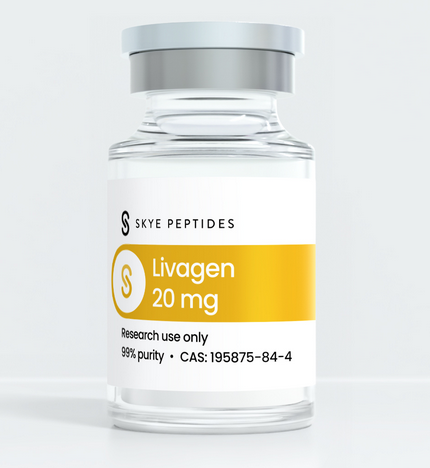
Livagen 20 mg
£69.00
Now shipping: Batch LIV26-25-001 99.9% purity | 23.5 mg
CAS Number: 195875-84-4
Molecular Formula: C₁₈H₃₁N₅O₉
Molecular Weight: 461.5 g/mol
Appearance: white powder
Storage: 2-8°
Purity: ≥99%
Livagen 20 mg — Liver Cell Regeneration Research Peptide (UK Supply)
Livagen 20 mg is a high-purity, research-grade peptide bioregulator studied in laboratory environments for its role in liver cell signalling, cellular repair mechanisms, and metabolic regulation pathways. In UK research settings, Livagen is used in controlled experimental models exploring hepatic cell response, DNA expression activity, and recovery processes associated with oxidative stress and cellular damage.
Supplied as a lyophilized peptide, Livagen 20 mg is formulated for stability, precision, and reproducible laboratory performance, making it suitable for structured research across cellular biology, metabolic science, and regenerative pathway studies.
Key Facts About Livagen 20 mg
| Feature | Details |
|---|---|
| Compound Type | Synthetic peptide bioregulator |
| Strength | 20 mg precision dose |
| Primary Focus | Liver cell support and regeneration research |
| Form | Lyophilized peptide powder |
| Stability | Long shelf life under recommended storage conditions |
| Applications | Hepatic studies, cellular repair, metabolic research |
| Intended For | UK universities, biomedical labs, and research institutions |
Research Uses
Livagen 20 mg is commonly used in UK laboratory research for:
- Liver cell regeneration and hepatic function studies
- Cellular DNA expression and regulation research
- Oxidative stress response and recovery investigations
- Detoxification pathway and metabolic signalling studies
- Cellular repair and tissue recovery modelling
Advantages for Laboratory Research
- High specificity for hepatic cellular research models
- Stable peptide structure for consistent experimental outcomes
- Precision dosing supports controlled laboratory applications
- Suitable for a wide range of metabolic and regenerative studies
- Reliable performance in in-vitro research environments
Why Choose Livagen 20 mg in the UK?
Livagen 20 mg is selected by researchers for its targeted relevance in liver biology and cellular regeneration studies. Its defined peptide structure allows for controlled investigation of hepatic signalling pathways, DNA expression activity, and metabolic recovery mechanisms under laboratory conditions.
In UK research environments, it is valued as a dependable tool for exploring liver cell function and regenerative biology within structured scientific studies.
Be the first to review “Livagen 20 mg”
Related products
Buy peptides UK
Reviews
There are no reviews yet.