
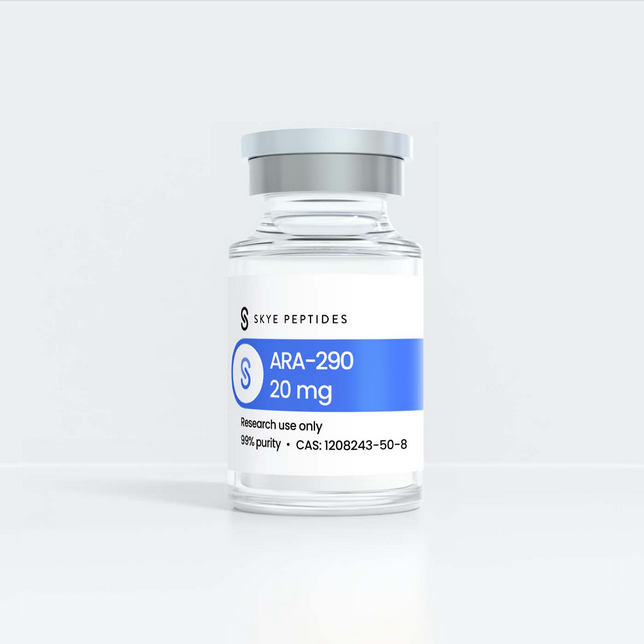
ARA-290 20 mg
£84.00
Now Shipping: Batch ARA25-16-004 99.5% purity | 20.85mg
CAS NO: 1208243-50-8
Molecular Formula: C51H84N16O21
Molecular Weight: 1257.3 g/mol
Appearance: white powder
Storage: 2-8°
Purity: ≥99%
ARA 290 Peptide — Erythropoietin-Derived Research Peptide (UK Supply)
ARA 290 is a high-purity, research-grade peptide derived from erythropoietin, widely studied in laboratory settings for its potential role in cellular protection, anti-inflammatory signalling, and tissue repair mechanisms. In UK research environments, it is used in controlled in-vitro and ex-vivo models to investigate immune modulation, cellular stress responses, and tissue regeneration pathways.
Supplied as a lyophilized peptide powder, ARA 290 is designed for stability, consistency, and reliable handling, supporting reproducible results across advanced biomedical and cellular research applications.
Key Facts About ARA 290
| Feature | Details |
|---|---|
| Compound Type | Synthetic erythropoietin-derived research peptide |
| Research Focus | Cellular protection, anti-inflammatory signalling, tissue repair |
| Form | Lyophilized peptide powder |
| Stability | High under recommended storage conditions |
| Storage | Refrigerated or frozen environments |
| Applications | Tissue regeneration, immune modulation, cellular signalling |
| Intended For | UK universities, biomedical labs, and research institutions |
Research Uses
ARA 290 is commonly applied in UK laboratory research for:
- Anti-inflammatory signalling pathway investigations
- Tissue repair and regeneration studies
- Cellular communication and immune modulation research
- In-vitro models of cellular stress and recovery mechanisms
- Comparative analysis of peptide-mediated biological responses
Advantages for Laboratory Research
- High-purity formulation supports consistent, reproducible outcomes
- Stable lyophilized format suitable for long-term research storage
- Compatible with a wide range of cellular and tissue research models
- Supports detailed investigation of immune and repair pathways
- Reliable performance in controlled experimental environments
Why Choose ARA 290 in the UK?
ARA 290 is selected by researchers for its relevance in studying cellular protection mechanisms and inflammatory response pathways. Its defined peptide structure allows for controlled experimentation in tissue repair and immune modulation research under strict laboratory conditions.
In UK scientific settings, it is valued as a dependable tool for exploring erythropoietin-derived signalling pathways and cellular recovery processes.
Be the first to review “ARA-290 20 mg”
Related products
Buy peptides UK
Reviews
There are no reviews yet.