
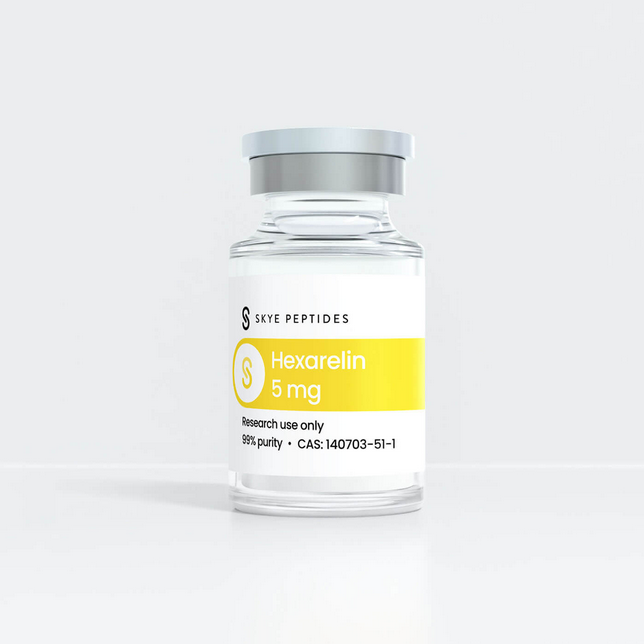
Hexarelin 5 mg
£44.00
Now shipping: Batch HEX25-5-001 99.5% purity | 6.42 mg
Please note that all products featured here are intended exclusively for research and development purposes. They are not designed for any form of human consumption
Hexarelin Peptides — Growth Hormone Secretagogue for Research (UK Supply)
Hexarelin peptides are synthetic, research-grade compounds widely studied in laboratory environments for their interaction with growth hormone signalling pathways and receptor activity. In UK research settings, Hexarelin is used in controlled in-vitro and ex-vivo studies to examine endocrine communication, peptide–receptor binding dynamics, and cellular signalling mechanisms involved in hormonal regulation.
Supplied as a lyophilized peptide powder, Hexarelin is designed for stability, consistent handling, and reproducible experimental performance, making it suitable for advanced endocrine and cellular signalling research.
Key Facts About Hexarelin Peptides
| Feature | Details |
|---|---|
| Compound Type | Synthetic growth hormone secretagogue peptide |
| Research Focus | Receptor signalling and endocrine pathway studies |
| Form | Lyophilized peptide powder |
| Stability | High under recommended storage conditions |
| Storage | Refrigerated or frozen environments |
| Applications | Endocrine signalling and cellular communication research |
| Intended For | UK universities, biomedical labs, and research institutions |
Research Uses
Hexarelin peptides are commonly used in UK laboratory research for:
- Growth hormone receptor interaction studies
- Endocrine signalling pathway investigations
- Peptide–receptor binding and communication research
- Hormonal feedback mechanism modelling (in-vitro)
- Cellular response analysis to peptide signalling
Advantages for Laboratory Research
- High-purity formulation supports consistent experimental outcomes
- Stable lyophilized format suitable for long-term storage
- Well-characterised receptor activity for controlled studies
- Compatible with a range of endocrine and cellular models
- Supports detailed investigation of peptide signalling pathways
Why Choose Hexarelin Peptides in the UK?
Hexarelin peptides are selected by researchers for their reliability, structural consistency, and relevance in endocrine signalling studies. Their defined activity profile allows for controlled experimentation into growth hormone receptor interactions and cellular communication pathways under laboratory conditions.
In UK research environments, they are valued as dependable tools for exploring peptide–receptor dynamics and hormonal signalling mechanisms in structured scientific studies.
Be the first to review “Hexarelin 5 mg”
Related products
Reviews
There are no reviews yet.